Epithalon — also transliterated as Epitalon or Epithalone — is a synthetic tetrapeptide that has become one of the most frequently referenced compounds in the study of pineal-derived peptide bioregulators. Composed of four amino acid residues in the sequence Alanine-Glutamate-Aspartate-Glycine (Ala-Glu-Asp-Gly, or AEDG), it was designed as a short peptide analogue of epithalamin, a polypeptide complex historically extracted from the pineal gland. This overview surveys the compound's molecular identity, its origins within the Khavinson bioregulator research program, and the laboratory pathways that the scientific literature has explored — strictly as an educational reference for researchers.
Molecular Identity and Characterization
Epithalon is a low-molecular-weight peptide whose defining feature is its brevity: just four residues, two of which (glutamate and aspartate) are acidic. This composition gives the molecule a net negative charge at physiological pH, a property that analytical chemists note when characterizing its behavior in solution and during chromatographic separation.
| Property | Value |
|---|---|
| Compound name | Epithalon (Epitalon) |
| Peptide sequence | Ala-Glu-Asp-Gly (AEDG) |
| CAS number | 307297-39-8 |
| Molecular formula | C14H22N4O9 |
| Compound class | Synthetic tetrapeptide bioregulator |
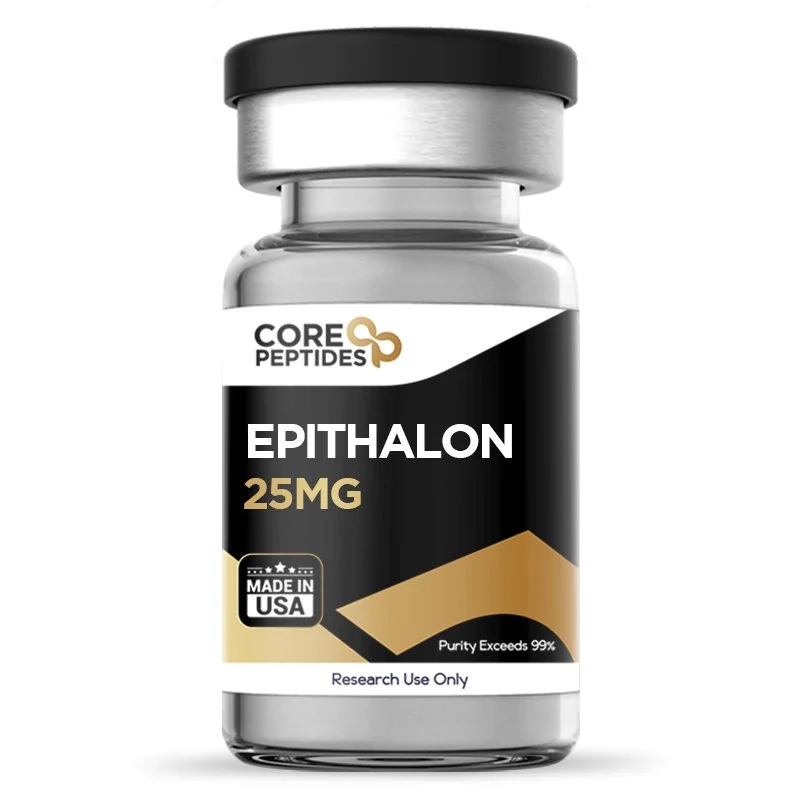
In the laboratory, characterization of Epithalon typically relies on high-performance liquid chromatography (HPLC) for purity assessment and mass spectrometry for confirmation of molecular weight and sequence integrity. Its small size and defined sequence make it a comparatively tractable subject for analytical method development. Reference materials such as Epithalon (25mg) are supplied for such in-vitro characterization and analytical work.
Origin: From Epithalamin to a Defined Peptide
Epithalon emerged from the work of Vladimir Khavinson and colleagues at the St. Petersburg Institute of Bioregulation and Gerontology. The research group had studied epithalamin — a peptide fraction obtained from the pineal gland — and sought to identify a short, chemically defined sequence that captured the active peptide motif of that larger extract. The result was the AEDG tetrapeptide, synthesized in the 1990s.
This progression from a tissue-derived polypeptide complex to a single defined synthetic peptide is characteristic of the broader class known as Khavinson peptide bioregulators — short peptides derived from, or modeled on, endogenous regulatory peptides. Readers interested in this wider family may consult our guide on bioregulator peptides, which situates Epithalon among related short-peptide compounds studied in preclinical settings.
Epithalon exemplifies the reductionist logic of peptide bioregulator research: distilling a complex tissue extract down to a single, reproducible, synthesizable four-residue sequence that laboratories can characterize with precision.
Telomere and Telomerase Research Pathways
A substantial portion of the Epithalon literature concerns the telomere-telomerase axis. Telomeres are the repetitive nucleotide caps at the ends of chromosomes, and telomerase is the ribonucleoprotein enzyme that can extend them. Researchers have investigated, in cell culture and animal models, whether Epithalon influences telomerase activity and telomere dynamics.
In vitro studies have examined the peptide's effects on telomerase expression in cultured somatic cell lines, exploring questions about cellular replicative capacity. These investigations are framed within basic cell biology and gerontology research — they characterize molecular and enzymatic responses in experimental systems, not outcomes in living humans. The telomere focus is a principal reason Epithalon appears so often in the peptide-and-aging research literature at the mechanistic level.
Pineal and Chronobiology Pathways
Given its lineage from a pineal-gland extract, Epithalon has also been studied in the context of pineal function and circadian signaling. Researchers have investigated, in animal models, the peptide's relationship to the pineal neuroendocrine system, including pathways associated with melatonin regulation and the timing signals the pineal gland is thought to help coordinate.
Additional preclinical work has looked at gene-expression modulation, examining whether short peptides of this type interact with regulatory regions of DNA. This proposed mode of action — short peptides influencing transcriptional regulation — is an area of active mechanistic inquiry across the bioregulator class rather than a settled conclusion for any single compound.
Why Epithalon Is Studied as a Model Peptide
Several features make Epithalon a recurring subject of investigation:
- Structural simplicity: a four-residue sequence is straightforward to synthesize, purify, and verify analytically.
- Defined identity: a single CAS registry (307297-39-8) and molecular formula (C14H22N4O9) support reproducibility across laboratories.
- Rich mechanistic questions: its links to telomere biology and pineal signaling connect it to several distinct fields of basic research.
- Bioregulator context: it serves as a reference example when comparing other short regulatory peptides.
For foundational context on how compounds of this kind are categorized and handled in a laboratory setting, see our primer on what research peptides are. High-purity reference material such as Epithalon (25mg) is intended solely to support this kind of controlled experimental characterization.
Handling and Analytical Notes
As a lyophilized synthetic peptide, Epithalon is generally handled under conditions that minimize degradation — controlled temperature, protection from moisture, and reconstitution with appropriate laboratory-grade solvents when required for in-vitro assays. Because the molecule carries acidic residues, its solubility and stability profile in buffered systems is a routine consideration during experimental design and analytical validation.
Research-use-only statement. Epithalon (Epitalon) is offered and described here exclusively for laboratory and in-vitro research purposes. Nothing in this overview constitutes medical, therapeutic, or health guidance, and the compound is not intended for human or veterinary use, diagnosis, treatment, or the prevention of any condition. All references to biological pathways describe findings in cell and animal models within the scientific literature. Researchers are responsible for compliance with applicable laws, institutional protocols, and safe-handling practices.