Research peptides are among the most widely handled compounds in modern life-science laboratories, yet the term is often used loosely. In precise terms, a peptide is a short chain of amino acids joined by peptide bonds, synthesized and purified for the express purpose of in vitro and preclinical laboratory investigation. This primer defines what peptides are, how they differ from proteins, how they are manufactured and stabilized, and why the compounds supplied for research are strictly research chemicals intended for laboratory study only. It is written for a scientifically literate audience — technicians, students, and investigators — who need a clear conceptual foundation before working with these materials.
Peptides Versus Proteins: A Question of Scale and Structure
Both peptides and proteins are built from the same twenty standard amino acids, and both rely on the peptide bond — a covalent amide linkage formed between the carboxyl group of one amino acid and the amino group of the next. The distinction is largely one of length and organizational complexity. Peptides are generally defined as chains of roughly 2 to 50 amino acid residues, whereas proteins are longer polypeptides that typically fold into stable, well-defined three-dimensional structures.
A useful way to frame the difference is by structural hierarchy. The primary structure is the linear amino-acid sequence itself. Secondary structure describes local motifs such as alpha-helices and beta-sheets stabilized by hydrogen bonding. Tertiary and quaternary structures describe the overall fold and the assembly of multiple chains. Many short peptides exist predominantly as flexible primary-structure chains in solution, while proteins depend on their higher-order folding to carry out their functions. This is why researchers frequently study peptides as tractable, well-characterized models for probing molecular interactions.
Amino-Acid Sequences and the Basis of Specificity
The identity and behavior of any peptide are encoded entirely in its sequence — the specific order of amino-acid residues from the N-terminus to the C-terminus. Each residue contributes a distinct side chain that may be charged, polar, hydrophobic, or aromatic, and the arrangement of these side chains determines how a peptide interacts with receptors, enzymes, metal ions, or other biomolecules in an experimental system.
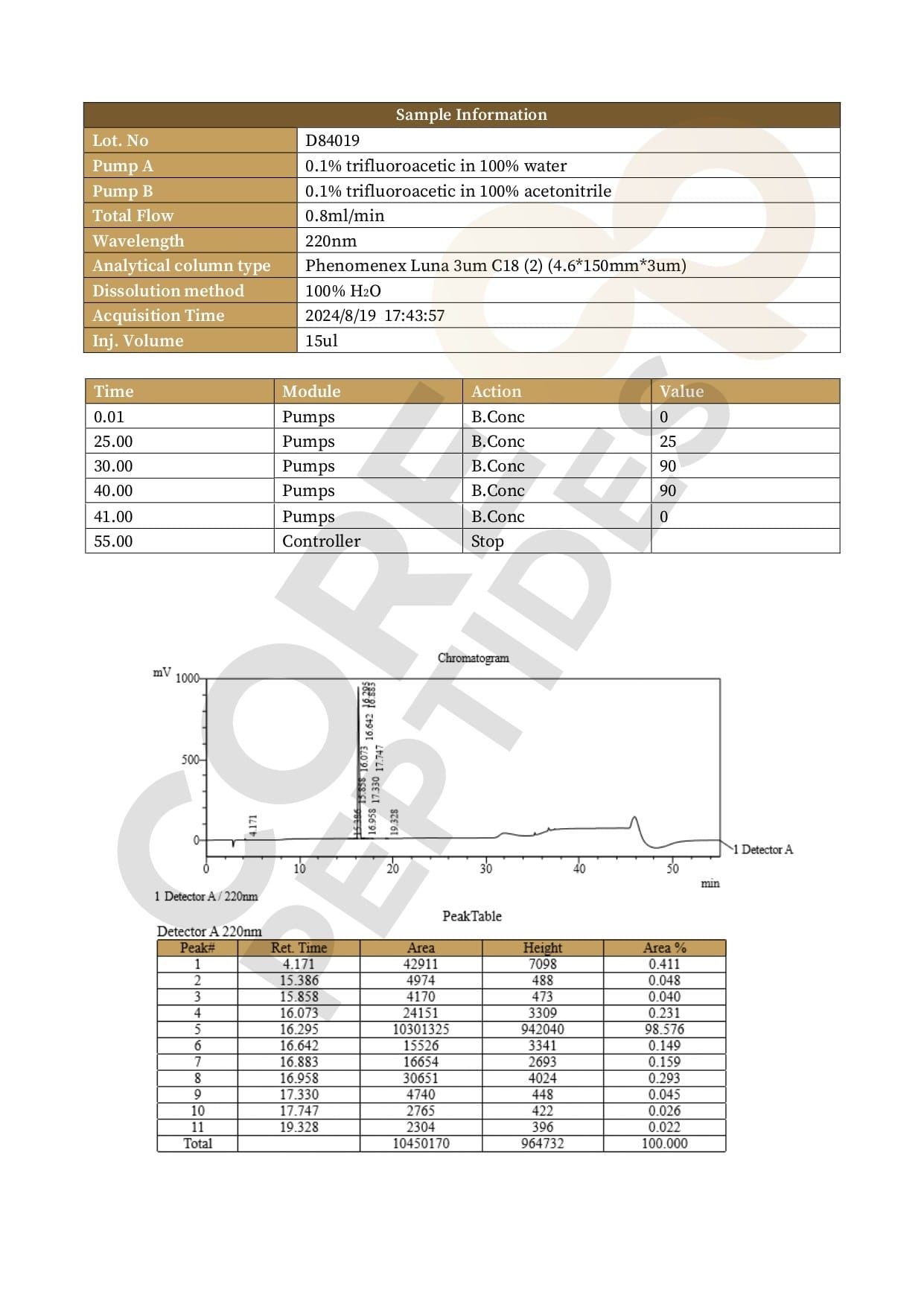
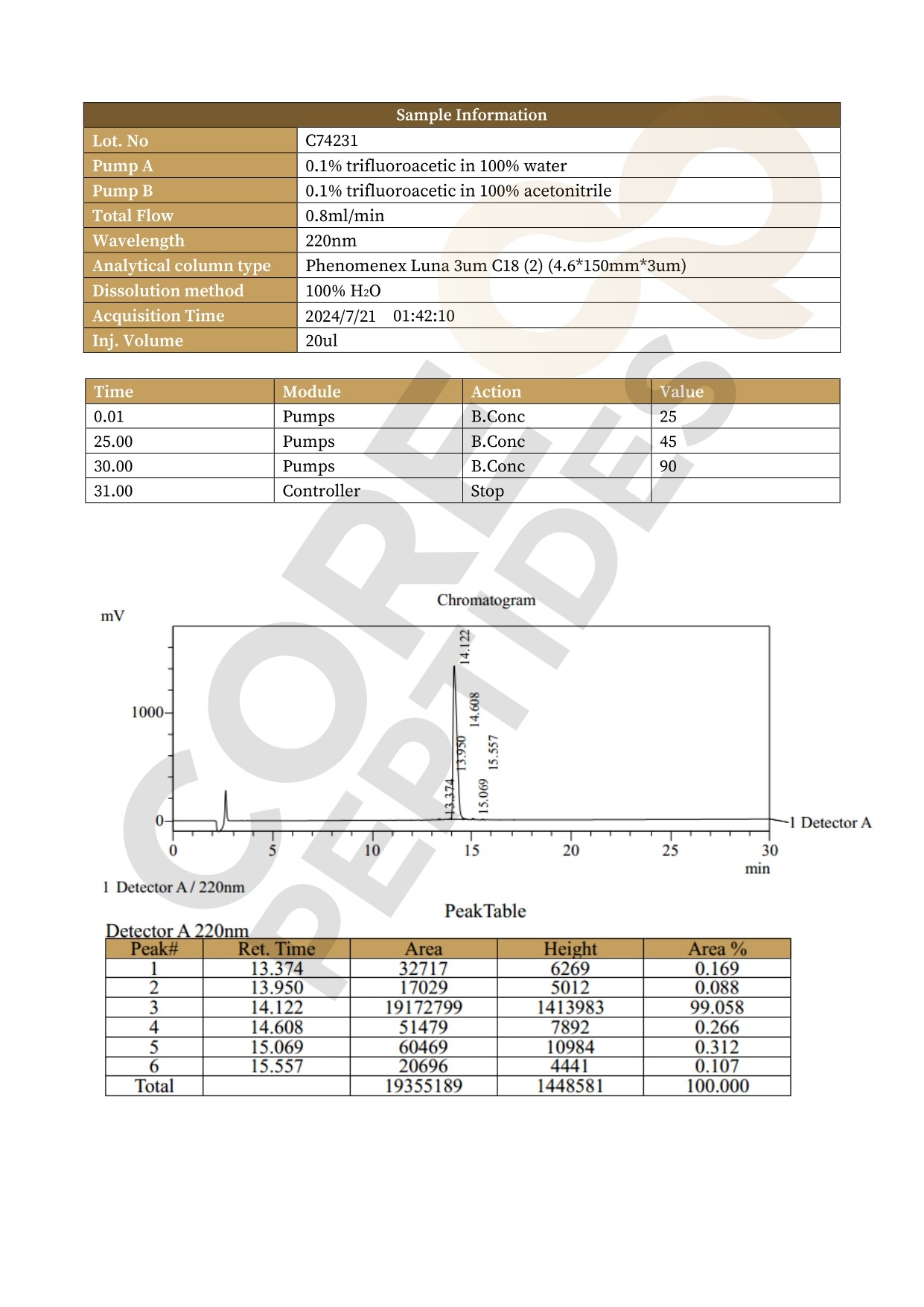
By convention, sequences are written using single-letter or three-letter amino-acid codes, read left to right from N- to C-terminus. Because a change of even a single residue can alter a molecule's binding characteristics or stability, sequence fidelity is a central concern in peptide science. Analytical confirmation of the intended sequence and structure is a routine part of characterization, and researchers verifying incoming material commonly consult the certificate of analysis that accompanies a compound.
The sequence is the molecule's blueprint: it defines not only what the peptide is, but which molecular pathways and interactions a laboratory can meaningfully investigate with it.
How Research Peptides Are Synthesized
The dominant manufacturing method for research peptides is solid-phase peptide synthesis (SPPS), a technique introduced in the 1960s that transformed peptide chemistry. In SPPS, the growing chain is anchored to an insoluble polymeric resin. Amino acids — each bearing a protecting group on its reactive amine — are added one at a time in repeating cycles.
Each synthetic cycle follows a consistent logic:
- Deprotection removes the temporary protecting group from the terminal amino acid, exposing a reactive site.
- Coupling activates the next protected amino acid so it forms a peptide bond with the exposed terminus.
- Washing flushes away excess reagents and by-products before the next cycle begins.
Two protecting-group strategies dominate the field: Fmoc (9-fluorenylmethoxycarbonyl) and Boc (tert-butyloxycarbonyl) chemistry. Once the full sequence is assembled, the peptide is cleaved from the resin and its side-chain protecting groups are removed. The crude product is then purified, most often by reversed-phase high-performance liquid chromatography (HPLC), and its identity is confirmed by mass spectrometry. Establishing purity is a defining step in preparing a research-grade compound; the general principles are covered in our guide to how peptide purity is verified.
Lyophilization and Physical Form
After purification, research peptides are most commonly supplied as a lyophilized (freeze-dried) powder. Lyophilization removes water by freezing the purified solution and then subliming the ice under vacuum, leaving a dry solid. This form offers meaningful advantages for a laboratory reagent: the dry powder is generally more stable during shipping and cold storage than a solution, and it minimizes hydrolytic and microbial degradation over time.
Because the material arrives as a solid, it must be brought into solution before any in vitro work. The choice of solvent, concentration, and handling conditions depends on the peptide's chemistry — factors that our overview of reconstituting lyophilized peptides examines from a laboratory-handling perspective.
Naming Conventions and Milligram Sizing
Research peptides are catalogued in several ways. Some carry systematic or descriptive names derived from their sequence or discovery context; others are known by research codes or abbreviations established in the scientific literature. A single compound may appear under multiple designations, so cross-referencing the stated molecular identity — and, where provided, an accompanying CAS number and molecular formula — is good laboratory practice.
Quantities are almost always specified by mass in milligrams (mg) rather than by molar amount, because a vial of lyophilized powder contains a defined weight of net peptide. Common vial sizes span a small range of milligram values. When converting a mass to a molar concentration for an experiment, researchers use the peptide's molecular weight, and they may also account for peptide content or net-peptide factors reported on the certificate of analysis, since a lyophilized solid can include associated counter-ions and residual moisture.
The Research-Use-Only Framework
Peptides supplied for laboratory work are classified and sold as research chemicals. They are intended solely for in vitro experimentation and preclinical laboratory study — for example, characterizing molecular structure, examining receptor and enzyme interactions in controlled systems, or serving as reference standards in analytical method development. They are not evaluated, formulated, or approved as drugs, foods, cosmetics, or medical products.
This distinction is both scientific and regulatory. Materials designated research-use-only have not undergone the review required for any human or veterinary application, and the "research chemical" framing exists precisely to keep such compounds within the controlled environment of a qualified laboratory. Investigators are responsible for handling these materials in accordance with applicable institutional, safety, and legal requirements in their jurisdiction.
Research-use-only notice: All peptides discussed in this article are supplied strictly for laboratory and in vitro research purposes only. They are not intended for human or veterinary use, and nothing here should be interpreted as guidance for any such application. This content is educational and describes the chemistry and research context of these compounds; it is not medical, therapeutic, or dosing advice of any kind.