GHK-Cu is one of the most extensively characterized copper-binding peptides in the biochemical literature, and its combination of a small, well-defined structure with a naturally occurring biological role has made it a recurring subject of laboratory investigation. Formed when the tripeptide glycyl-L-histidyl-L-lysine (Gly-His-Lys, or GHK) coordinates a copper(II) ion, the complex sits at the intersection of peptide chemistry, trace-metal biology, and the study of extracellular matrix remodeling. For researchers working with copper-binding motifs, GHK-Cu serves as a compact model system for examining how a short amino acid sequence can carry and present a redox-active metal to cellular environments in vitro.
Molecular Identity and Characterization
GHK-Cu is the copper(II) complex of the tripeptide glycyl-L-histidyl-L-lysine and is registered under CAS number 89030-95-5. The peptide backbone consists of three residues — glycine, histidine, and lysine — in which the imidazole side chain of histidine, the terminal amine, and backbone nitrogen atoms provide the principal donor groups that coordinate the copper ion. This arrangement gives the tripeptide a high affinity for divalent copper, a feature that has been examined through spectroscopic and computational studies of the metal-binding geometry.
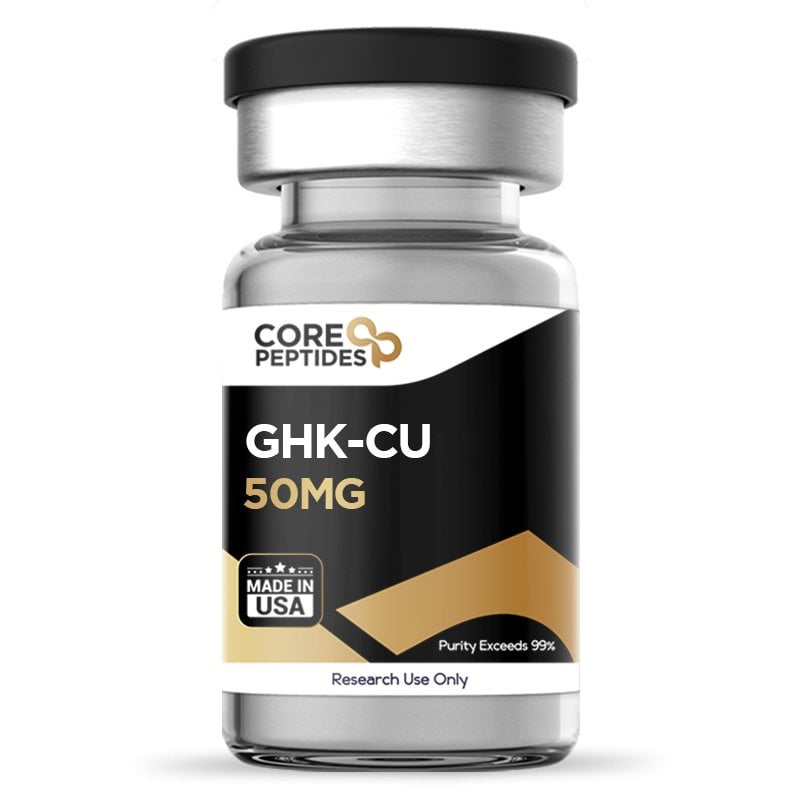
Analytical characterization of GHK-Cu in research settings typically involves mass spectrometry to confirm the peptide mass, high-performance liquid chromatography to assess purity, and UV-visible or electron paramagnetic resonance spectroscopy to probe the copper coordination environment. Because the free peptide (GHK) and the copper complex (GHK-Cu) have distinct properties, laboratories often distinguish between the two forms; the uncomplexed peptide is available for study as GHK Basic (50mg), while the pre-formed copper complex is studied as GHK-Cu (Copper) (50mg).
Natural Occurrence in Plasma
Unlike many synthetic research peptides, GHK was originally identified as a naturally occurring component of human plasma. Analytical work established that the tripeptide is present in circulation, and its plasma concentration has been reported in the biochemical literature to vary across sampled populations. This endogenous origin is one of the reasons GHK-Cu has drawn sustained scientific interest: it is not a purely artificial construct but a molecule with a documented biological presence, which allows researchers to study it in the context of natural copper handling.
The observation that GHK circulates alongside a labile pool of copper has framed much of the mechanistic literature, which asks how a small peptide might participate in the distribution and buffering of a trace metal that is both essential and potentially reactive.
Copper Transport and Coordination Pathways
A central theme in GHK-Cu research is the peptide's proposed role as a copper carrier. Copper(II) is a redox-active ion, and its free form can participate in reactions that generate reactive oxygen species. Peptides and proteins that bind copper tightly can sequester the ion and present it in a controlled coordination state. In vitro studies have examined how GHK binds copper, the stability constants of the resulting complex, and how the metal might be exchanged with other copper-binding molecules present in biological fluids.
Researchers have investigated GHK-Cu as a comparatively simple ligand system for probing questions in bioinorganic chemistry — for example, how coordination geometry influences the redox behavior of bound copper, and how a peptide-metal complex behaves relative to the free peptide and free metal ion.
The compact, well-defined structure of GHK-Cu makes it a useful model complex for studying how a short peptide sequence coordinates, stabilizes, and presents a redox-active metal ion in laboratory systems.
Extracellular Matrix and Remodeling Studies In Vitro
Beyond its metal-binding chemistry, GHK-Cu has been studied in cell-culture models concerned with the extracellular matrix. In vitro studies have examined the peptide complex in relation to fibroblast behavior and the expression of matrix components, and gene-expression profiling work has been used to catalog transcriptional changes associated with GHK-Cu exposure in cultured cells. This body of work situates GHK-Cu within the broader research area of tissue matrix biology and cellular signaling, where investigators map the pathways a compound engages rather than assert any outcome.
These investigations are conducted entirely in laboratory model systems — isolated cells, culture assays, and biochemical preparations — and are used by researchers to generate hypotheses about mechanism rather than to characterize effects in living subjects.
Solution-Phase Versus Topical Research Contexts
The GHK-Cu literature can be broadly divided into two experimental contexts. One line of work studies the peptide complex in solution-phase and cell-based systems, treating it as a bioinorganic and signaling molecule of interest. A second line of work approaches GHK-Cu from a cosmetic-science and formulation-research angle, where investigators study the stability, penetration, and material behavior of the complex in topical preparations. This dual framing is common among peptides that occur naturally and also possess physicochemical properties relevant to formulation science.
For formulation-oriented laboratory work, a higher-mass topical research variant is studied as GHK-Cu (200mg). Researchers comparing GHK-Cu across these contexts often review the broader category of cosmetic and topical peptides, and those newer to the field may find general background in the overview of what research peptides are.
Why GHK-Cu Remains a Research Reference Point
Several factors keep GHK-Cu in circulation as a laboratory reference compound: its small and unambiguous structure, its status as a naturally occurring plasma constituent, its well-defined copper coordination chemistry, and the volume of published in vitro and model-system work that provides a comparative baseline. Together these make it a convenient benchmark for scientists studying copper-binding peptides, metal transport chemistry, and matrix-related cellular pathways.
Research-use-only statement: The information above is provided strictly for educational and scientific reference. GHK-Cu and all related peptides described here are intended solely for laboratory and in-vitro research use. They are not drugs, dietary supplements, cosmetics, or medical products, and nothing in this article describes or endorses any human or veterinary use. Any handling of these materials should be performed only by qualified personnel in an appropriate research setting and in accordance with applicable laws and institutional guidelines.