Peptides are chemically defined but physically fragile molecules. In the research setting, the difference between a reference-grade reagent and an unreliable one often comes down to how the material was stored between synthesis and the moment it enters an assay. Chain scission, oxidation, deamidation, aggregation, and adsorption to container surfaces can all degrade a peptide long before it visibly changes, quietly compromising reproducibility. This guide surveys the storage and stability science that underpins sound handling of research peptides — from the lyophilised powder in its vial to the reconstituted working stock on the bench — with a focus on the physical and chemical factors that laboratories control.
Why peptides degrade: the chemistry behind instability
A peptide's stability is governed largely by its amino acid sequence. Certain residues carry well-characterised chemical liabilities that researchers should recognise when planning storage. Methionine and, to a lesser extent, tryptophan and cysteine are susceptible to oxidation, particularly in the presence of atmospheric oxygen, trace metal ions, or light. Cysteine thiols can also form unintended disulfide bonds, leading to dimerisation or scrambled connectivity. Asparagine and glutamine residues are prone to deamidation, while aspartate can undergo isomerisation, both of which alter mass and charge. N-terminal glutamine may cyclise to pyroglutamate. These pathways are accelerated by heat, moisture, extremes of pH, and oxidative conditions — which is precisely why cold, dry, dark, inert storage is the standard.
Sequence length and composition also affect aggregation propensity. Hydrophobic and beta-sheet-forming peptides can associate into oligomers or fibrils in solution, a process that is concentration- and temperature-dependent and frequently irreversible.
Storing lyophilised peptides
Lyophilisation (freeze-drying) removes water and dramatically slows the hydrolytic and enzymatic reactions that require it, which is why most research peptides are supplied and stored as a dry powder. To preserve that advantage, the lyophilised material should be kept:
- Cold. Long-term storage is typically at −20 °C or lower; many laboratories use −80 °C for extended archival of sensitive sequences.
- Sealed and desiccated. Keep the vial tightly closed with intact seals, ideally inside a secondary container with desiccant, so the hygroscopic powder does not draw in atmospheric moisture.
- Away from light. Amber vials or opaque secondary packaging limit photo-oxidation of light-sensitive residues.
- Under an inert atmosphere where possible. Displacing headspace oxygen (for example with argon or nitrogen) further protects oxidation-prone sequences.
Handled this way, well-characterised lyophilised peptides are generally stable for extended periods. The single most damaging bench error is opening a cold vial before it has equilibrated to room temperature: condensation forms on the cold surface, introducing exactly the moisture the freeze-drying removed.
Cold, dry, dark, and sealed is not a slogan — it is a direct countermeasure to the four chemical pathways (hydrolysis, oxidation, deamidation, aggregation) that most commonly degrade peptides in storage.
Reconstitution and the working-stock window
Once a peptide is dissolved, water re-enters the system and degradation chemistry resumes. Reconstituted peptide solutions are therefore far less stable than the dry powder and are best treated as short-lived working stocks. General practice is to keep solutions refrigerated at 2–8 °C for near-term use and to consume them within a compound-appropriate window rather than storing indefinitely. That window varies with sequence, solvent, pH, and concentration; oxidation-prone or aggregation-prone peptides warrant shorter timelines. For a detailed treatment of solvent selection and handling, see our companion guide on reconstituting lyophilized peptides.
Two practical considerations recur in solution. First, dilute peptides can adsorb to glass and plastic surfaces, lowering the effective concentration in the vessel; low-binding tubes and carrier proteins are common laboratory mitigations. Second, solution pH strongly influences deamidation and hydrolysis rates, so buffer choice is part of stability, not an afterthought.
Freeze-thaw considerations
For solutions intended to outlast the refrigerated window, freezing is the usual route — but each freeze-thaw cycle is a stress event. The physical act of ice formation concentrates solutes, shifts local pH, and creates ice-water interfaces that can drive aggregation and denaturation. Because these effects accumulate, the standard mitigation is to aliquot before freezing: divide the reconstituted stock into single-use volumes so each is thawed only once. Freezing rapidly and thawing gently, then mixing thoroughly to reverse any concentration gradients, are additional common practices. Repeatedly thawing and refreezing one master tube is the classic way to silently ruin an otherwise good peptide.
Desiccation, moisture, and container integrity
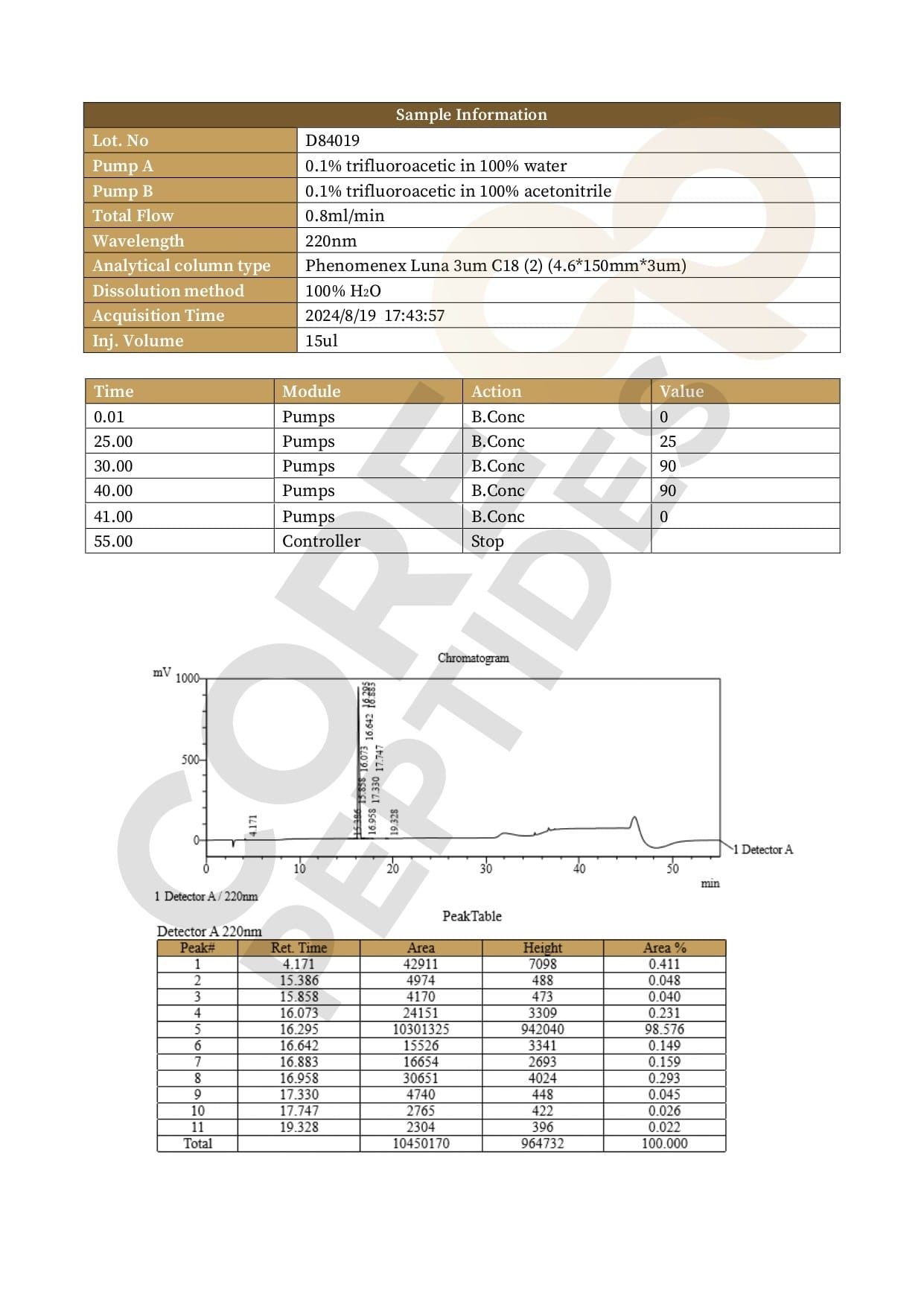
Moisture is the throughline connecting most storage failures. Many peptides — especially those containing acidic residues or counter-ions such as acetate or trifluoroacetate — are hygroscopic and will pull water from humid air. Absorbed water not only enables hydrolysis and deamidation but also complicates accurate weighing, since the powder's mass no longer reflects peptide content alone. Robust desiccation practice therefore serves both stability and quantitation: store powders with fresh desiccant, minimise the time vials spend open, and work quickly in humid environments. Container integrity matters too — degraded seals, cracked vials, or reactive closures can admit oxygen and moisture regardless of freezer temperature. Verifying identity and purity against supplier documentation, as discussed in our guide on reading a certificate of analysis, gives a reference point against which storage-related changes can later be judged.
Building a storage strategy for the lab
No single rule fits every sequence, but a defensible default emerges from the chemistry: archive lyophilised material cold, dark, sealed, and desiccated; reconstitute only what is needed; refrigerate working stocks and use them within a compound-appropriate window; and aliquot anything destined for the freezer to avoid repeated thaws. Sequences flagged for oxidation (methionine, cysteine) or deamidation (asparagine, glutamine) deserve the most conservative handling and, where feasible, inert headspace and light protection. Documenting storage conditions and dates alongside lot information turns stability from guesswork into a controlled, reproducible variable.
All peptides and related compounds referenced here are intended strictly for laboratory and in-vitro research use only. Nothing in this article constitutes guidance for human or veterinary use, and none of the storage or handling considerations described should be interpreted as medical, therapeutic, or dosing advice. Core Peptides supplies materials solely for scientific research conducted by qualified professionals in appropriately equipped facilities.