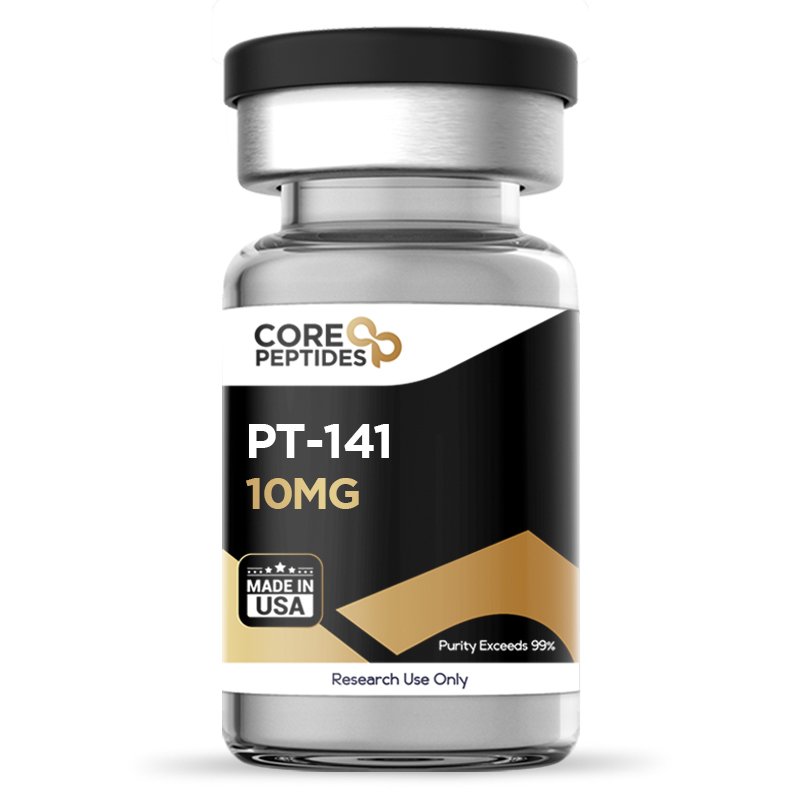
PT-141, known by the developmental designation bremelanotide, is a synthetic cyclic peptide belonging to the melanocortin family. It is structurally derived from Melanotan II, an earlier melanocortin analogue, and has become a frequent subject of laboratory investigation into melanocortin-receptor signalling. In the research setting, PT-141 serves as a tool compound for scientists examining how melanocortin peptides engage their receptor targets at the molecular level. This overview summarises the compound's chemical identity and the receptor-pathway research areas that the scientific literature has explored, framed strictly for laboratory and in-vitro contexts.
Molecular Identity and Characterization
PT-141 is catalogued under CAS registry number 189691-06-3. It is a cyclic heptapeptide analogue within the melanocortin class, distinguished from its parent structure, Melanotan II, by chemical modifications to the peptide backbone and terminal groups. Where Melanotan II is a cyclic lactam, the bremelanotide structure carries a modified terminus, which alters its physicochemical profile relative to the parent molecule. Because it is a defined synthetic sequence, the compound can be reproduced consistently between laboratory lots, a property that underpins its usefulness as a reference material in comparative work.
In analytical laboratories, peptides of this type are commonly characterized using high-performance liquid chromatography (HPLC) to assess purity and mass spectrometry to confirm molecular weight and sequence identity. Researchers working with reference-grade material typically rely on such techniques, alongside amino-acid analysis, to verify that a given lot matches its expected structure before it is used in experimental work. Documented purity and confirmed identity are prerequisites for reproducible results in any downstream binding or signalling assay.
Relationship to Melanotan II
Because PT-141 is a structural relative of Melanotan II, the two compounds are frequently discussed together in the peptide-chemistry literature. The lineage is relevant to researchers cataloguing structure-activity relationships across the melanocortin series, where small, deliberate changes to a shared scaffold are used to probe how structure maps onto receptor engagement. For broader context on this compound family, see our Melanotan research guide.
Melanocortin Receptor Pathways
The melanocortin system comprises a family of G-protein-coupled receptors, conventionally designated MC1R through MC5R. These receptors respond to endogenous melanocortin peptides and are distributed across a range of tissues studied in animal and cell-based models. Melanocortin analogues such as PT-141 have been investigated in the laboratory for their capacity to act as agonists at several of these receptor subtypes.
Preclinical and in-vitro research on melanocortin analogues has commonly examined several distinct questions:
- Receptor binding characterization — in-vitro assays measuring the affinity of the peptide for individual melanocortin receptor subtypes.
- Receptor subtype selectivity — comparative studies exploring how a given analogue distinguishes between MC1R, MC3R, MC4R and other subtypes.
- Downstream signalling — cell-based work investigating second-messenger responses, such as cyclic AMP accumulation, following receptor activation.
- Structure-activity relationships — systematic comparison of related peptides to map how structural changes influence receptor engagement.
Within melanocortin research, PT-141 is best understood as a receptor-agonist tool compound: a molecule whose value in the laboratory lies in its defined interaction with specific G-protein-coupled receptor subtypes.
Central Melanocortin Signalling in Animal Models
The MC4R subtype in particular has been a focus of neuroscience research in animal models, where it is examined as part of central nervous system signalling pathways. Melanocortin agonists have served as pharmacological probes in these preclinical studies, helping researchers dissect the roles that individual receptor subtypes play within larger physiological circuits. Such work is conducted entirely in experimental systems and forms part of the basic-science literature on GPCR signalling.
Research History
PT-141 emerged from work on melanocortin peptides that began with the characterization of Melanotan II. As investigators studied the melanocortin series, structural analogues were synthesized to probe how modifications to the peptide affected receptor interaction. Bremelanotide arose from this line of medicinal-chemistry investigation and has since appeared in the scientific literature as a well-defined melanocortin-receptor agonist used in laboratory research. Its consistent structure and documented receptor activity are what make it a useful reference point for comparative pharmacology studies.
Handling and Laboratory Context
As with other research peptides, PT-141 is typically supplied as a lyophilized (freeze-dried) powder. Peptides of this class are generally stored under conditions intended to preserve structural integrity, with attention to temperature, moisture and light exposure, in line with standard laboratory practice for synthetic peptides. Researchers sourcing material such as PT-141 (Bremelanotide) (10mg) for characterization work commonly review certificate-of-analysis data to confirm identity and purity prior to experimental use.
For readers new to this category of laboratory reagent, our overview of what research peptides are provides background on how these compounds are defined, characterized and handled in a research context.
Summary
PT-141 (bremelanotide) is a synthetic melanocortin-receptor agonist peptide, identified by CAS number 189691-06-3 and structurally derived from Melanotan II. In the scientific literature it appears principally as a tool compound for the study of melanocortin receptor subtypes and their signalling pathways, investigated through in-vitro binding assays, cell-based signalling studies and animal-model research. Its defined structure and receptor activity make it a recurring reference within melanocortin pharmacology.
This article is provided for educational and informational purposes only. PT-141 (bremelanotide) is offered strictly for laboratory and in-vitro research use. It is not a drug, dietary supplement, cosmetic or food, and it is not intended for human or veterinary use, diagnosis, treatment or any therapeutic application. All handling should be carried out by qualified personnel in an appropriately equipped research environment.