Sermorelin is a synthetic 29-amino-acid peptide corresponding to the biologically active N-terminal fragment of human growth-hormone-releasing hormone (GHRH). Designated by CAS number 86168-78-7, it has become a widely referenced compound in laboratory investigations of the growth-hormone (GH) axis. Because the 1-29 segment represents the shortest fragment of GHRH that retains full intrinsic activity at its cognate receptor, Sermorelin occupies a distinctive place in peptide chemistry and receptor pharmacology as a minimal, well-characterized GHRH analog. This overview summarizes what the compound is, how it relates to endogenous GHRH, and the research areas the scientific literature has explored. All information is presented for laboratory and educational context only.
Molecular Identity and Characterization
Sermorelin is formally identified by the CAS registry number 86168-78-7. Its structure is a linear chain of 29 amino acid residues terminating in a C-terminal amide, a modification associated with the native hormone's active conformation. In analytical and research contexts, the peptide is frequently supplied and studied as an acetate salt to improve handling and stability characteristics.
Structural characterization of Sermorelin in the literature typically relies on standard analytical techniques used for peptides of this class, including high-performance liquid chromatography (HPLC) for purity assessment and mass spectrometry for confirmation of molecular mass and sequence integrity. These methods allow researchers to verify identity and to distinguish the intact peptide from degradation fragments or synthesis-related impurities. The defined, comparatively short sequence makes Sermorelin a convenient reference standard when validating analytical workflows for GHRH-related peptides.
Nomenclature
The compound is commonly denoted in the literature as GHRH (1-29) or GRF (1-29) amide, reflecting its derivation from the first 29 residues of the full 44-residue growth-hormone-releasing hormone. Both designations refer to the same amino acid backbone.
Relationship to Endogenous GHRH
Endogenous growth-hormone-releasing hormone is a hypothalamic peptide that, in mammalian physiology, is released and travels to the anterior pituitary, where it interacts with the GHRH receptor (GHRH-R), a member of the class B G-protein-coupled receptor (GPCR) family. Full-length GHRH comprises 44 amino acids, but decades of structure-activity research established that the receptor-binding and activation determinants reside within the N-terminal portion of the molecule.
Sermorelin embodies this finding: it retains the residues essential for receptor recognition and signal initiation while omitting the C-terminal region that contributes little to intrinsic potency. This makes it a useful model peptide for investigators studying which structural elements of GHRH drive receptor engagement. In effect, Sermorelin functions as a molecular tool for probing the minimal pharmacophore of the GHRH system.
As the shortest fully active fragment of growth-hormone-releasing hormone, Sermorelin serves as a benchmark peptide for mapping the structural determinants of GHRH-receptor interaction.
Mechanistic Research on the GH Axis
In preclinical and in vitro research, Sermorelin has been examined as a representative agonist of the GHRH receptor. Studies of this class of peptide typically focus on the downstream signaling cascade that follows receptor activation, including the coupling of GHRH-R to the adenylyl cyclase pathway and the resulting changes in intracellular cyclic AMP within pituitary somatotroph cell models. Researchers have used such systems to characterize receptor binding, signaling efficacy, and the comparative behavior of GHRH analogs.
Because Sermorelin reproduces the core activity of native GHRH, it is often positioned as a reference compound against which newer or modified secretagogue peptides are compared. Investigators mapping the broader landscape of growth-hormone-axis modulators frequently include GHRH-analog references alongside other secretagogue classes; readers interested in that wider context may find our overview of growth hormone secretagogues a useful companion resource. For studies focused on longer-acting GHRH-analog chemistry, the CJC-1295 research guide discusses a related structural approach.
Use as a Reference and Comparator Compound
A recurring theme in the literature is the deployment of Sermorelin as a comparator in research on peptide stability, receptor selectivity, and analog design. Its short, unmodified sequence gives it a relatively brief metabolic profile in experimental systems, which has itself been a subject of investigation and a motivation for the design of structurally stabilized analogs. When researchers introduce modifications intended to alter degradation susceptibility or binding characteristics, Sermorelin often provides the baseline against which those changes are measured.
- Analytical reference: a defined standard for calibrating chromatographic and mass-spectrometric methods applied to GHRH-related peptides.
- Pharmacological comparator: a baseline agonist for evaluating the relative potency and efficacy of novel GHRH-receptor ligands in cellular assays.
- Structural template: a minimal-fragment scaffold used in structure-activity studies of the GHRH pharmacophore.
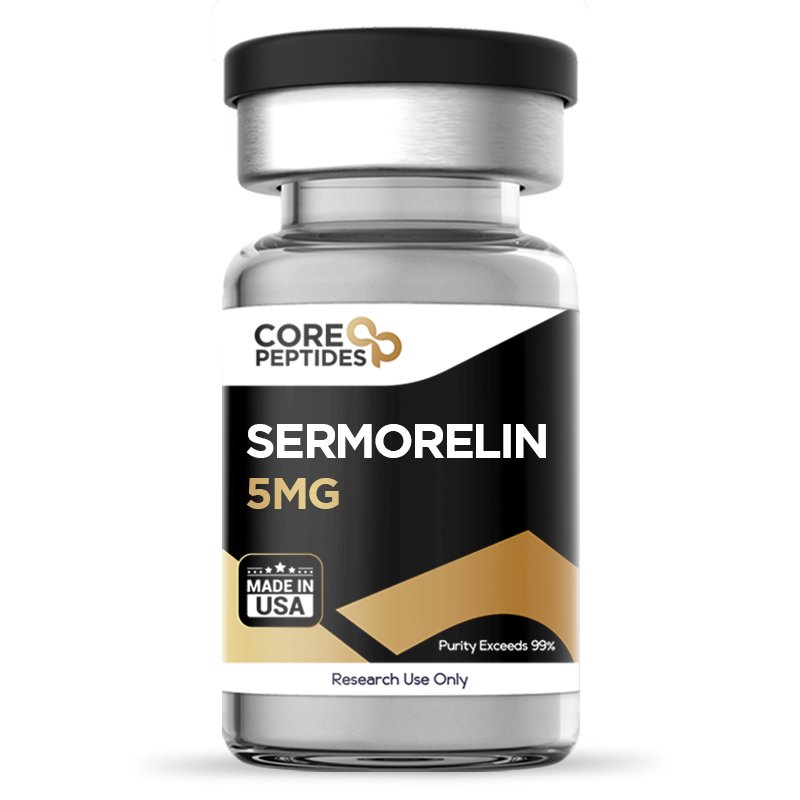
Laboratories sourcing well-characterized material for these purposes may reference research-grade preparations such as Sermorelin (5mg), while combination preparations such as the Sermorelin & Ipamorelin Blend (10mg) are of interest to investigators comparing secretagogue peptide classes.
Research History and Context
Sermorelin emerged from the extensive body of work that followed the isolation and sequencing of GHRH, when investigators sought to determine the minimal peptide required to reproduce the hormone's receptor activity. The identification of the 1-29 amide fragment as fully active was a significant milestone in GHRH structure-activity research and established the molecular basis for Sermorelin's continued use as a study compound. Since then it has remained a fixture in the GHRH literature, frequently cited whenever the growth-hormone axis, GHRH-receptor pharmacology, or secretagogue peptide design is the subject of investigation.
This article is provided strictly for educational and informational purposes. Sermorelin and related peptides described here are intended for laboratory and in-vitro research use only. They are not drugs, dietary supplements, or articles for human or veterinary use, and nothing in this overview should be interpreted as describing any diagnostic, therapeutic, or clinical application.