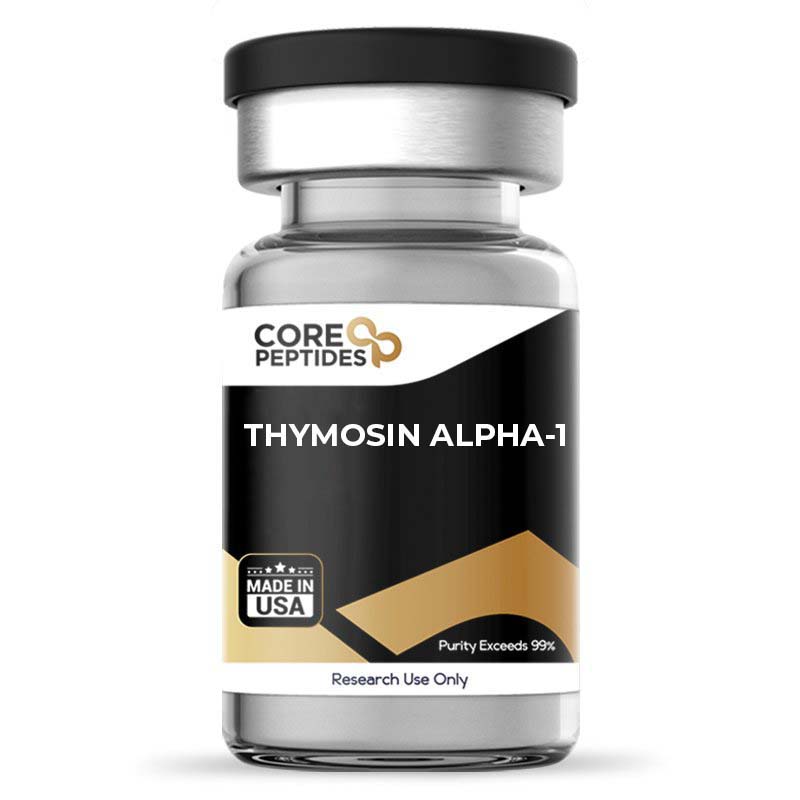
Thymosin Alpha-1 (Tα1) and Thymalin are two thymus-derived peptide preparations that have featured prominently in the immunomodulation literature. Both trace their origins to research into the thymus gland as an endocrine organ and the search for the soluble signalling factors it secretes. Although they are frequently discussed together because of their shared thymic provenance, they are chemically distinct: Thymosin Alpha-1 is a single, precisely defined 28-residue peptide, whereas Thymalin is a polypeptide fraction isolated from thymic tissue. This overview surveys their molecular identity, the historical arc of their characterization, and the research domains in which they appear — strictly as subjects of laboratory investigation.
Molecular Identity and Characterization
Thymosin Alpha-1 is a synthetically reproducible, N-terminally acetylated peptide of 28 amino acids, catalogued under CAS 62304-98-7. It was originally identified as a component of the partially purified preparation historically termed "thymosin fraction 5," from which the individual alpha-, beta-, and other sub-peptides were subsequently separated and sequenced. Because its primary structure is fully defined, Tα1 can be produced by solid-phase peptide synthesis and characterized analytically by techniques such as reversed-phase high-performance liquid chromatography (HPLC) for purity assessment and mass spectrometry for confirmation of molecular weight.
Thymalin, by contrast, is described in the literature as a peptide bioregulator — a low-molecular-weight polypeptide complex extracted from the thymus. Rather than being a single sequence, it is characterized as a fraction, and analytical work on such preparations focuses on peptide content, molecular-weight distribution, and batch-to-batch consistency. Researchers interested in the broader category of tissue-derived regulatory peptides often place Thymalin within the framework discussed in our guide to bioregulator peptides.
Comparing the Two Preparations
| Attribute | Thymosin Alpha-1 | Thymalin |
|---|---|---|
| Chemical nature | Defined 28-residue peptide | Thymic polypeptide fraction |
| Identity reference | CAS 62304-98-7 | Fraction, not single CAS |
| Origin of characterization | Isolated from thymosin fraction 5 | Extracted from thymic tissue |
| Typical analytics | HPLC, mass spectrometry | Peptide-content profiling |
Historical Background
Interest in thymic peptides grew out of mid-twentieth-century observations that the thymus was not merely a lymphoid organ but appeared to release soluble factors influencing the maturation of immune-cell populations in experimental systems. Fractionation of thymic extracts led to the isolation of a series of candidate peptides, of which Thymosin Alpha-1 became one of the most extensively studied because of its clear sequence definition. Parallel work in other research traditions produced tissue-extract preparations such as Thymalin, positioning both within the larger investigation of how the thymus signals to developing lymphocytes.
The recurring theme across the thymic-peptide literature is signalling: how small, tissue-derived molecules may modulate the differentiation and activity of immune-cell lineages in controlled experimental models.
Research Areas in the Literature
The scientific literature has examined thymic peptides across several mechanistic themes. In preclinical and in vitro contexts, researchers have investigated:
- Lymphocyte maturation pathways — how thymic signalling molecules relate to the differentiation of T-cell populations in cell-culture and animal-model systems.
- Innate-immune and receptor signalling — studies exploring interactions of Tα1 with pattern-recognition receptor pathways, including Toll-like receptor signalling, as a proposed mechanism of immunomodulation.
- Cytokine expression profiles — laboratory measurements of how exposure to thymic peptides correlates with the expression of signalling molecules in model systems.
- Structure–activity relationships — analytical and computational work relating the defined sequence of Thymosin Alpha-1 to its observed behaviour in binding and cell-based assays.
For readers new to how such compounds are categorized and handled in a laboratory setting, our primer on what research peptides are provides useful context on terminology and characterization standards.
Analytical Handling in the Laboratory
Because Thymosin Alpha-1 has a fixed sequence, it lends itself to rigorous quality control. Investigators typically confirm identity by mass spectrometry, assess purity chromatographically, and evaluate stability under defined storage conditions. Lyophilized peptide material is commonly reconstituted only for analytical or in vitro experimental work, with attention to solvent compatibility and aggregation behaviour. Thymalin preparations, being fractions, are instead evaluated on the consistency of their peptide profile across lots — an analytical challenge distinct from single-peptide verification.
Availability for Research
Both compounds are offered as reference materials for laboratory investigation. Researchers sourcing these peptides for characterization or in vitro study may reference Thymosin Alpha-1 and Thymalin, each intended solely to support controlled experimental work. Selecting between a defined single peptide and a thymic fraction depends on the experimental question — whether the aim is to probe a specific sequence or to study a tissue-derived polypeptide complex.
Summary
Thymosin Alpha-1 and Thymalin represent two approaches to the same underlying scientific question: how thymus-derived peptides participate in immune signalling. Tα1 offers the precision of a fully sequenced, analytically tractable molecule, while Thymalin embodies the tissue-fraction bioregulator tradition. Together they illustrate the breadth of the thymic-peptide research field, from molecular characterization through mechanistic study in models.
All information presented here is provided strictly for educational and scientific reference. Thymosin Alpha-1, Thymalin, and all related compounds discussed are intended for laboratory and in-vitro research use only. They are not drugs, foods, or supplements, and are not intended for human or veterinary use, diagnosis, treatment, or any form of clinical application.