Among the peptide fragments derived from human growth hormone (hGH), few have attracted as much sustained laboratory interest as the C-terminal region and its engineered analogs. HGH Fragment 176-191 and AOD-9604 are two closely related molecules that have become reference tools in preclinical investigations of lipid metabolism. Both correspond to the tail end of the growth hormone sequence, yet they differ in ways that have made them useful for probing how a small fragment of a large hormone can retain a specific biochemical signature while shedding the broader activity of the parent molecule. This overview describes what these compounds are, how they are characterized analytically, and the research areas the literature has explored in animal models and in vitro systems.
Molecular Identity: The C-Terminal Fragment
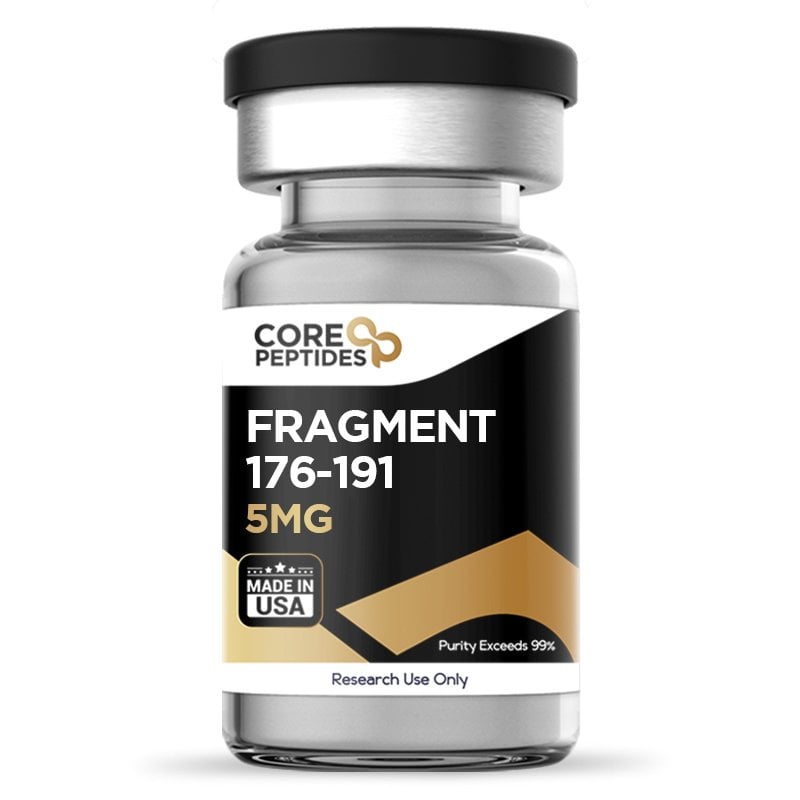
HGH Fragment 176-191 is a synthetic peptide corresponding to the amino acid residues numbered 176 through 191 at the carboxyl terminus of the 191-residue human growth hormone chain. It carries the CAS registry number 66004-57-7. As a defined 16-residue sequence, it represents only a small structural region of the full hormone and does not reproduce the folded domains through which intact hGH engages the growth hormone receptor.
This structural distinction is central to why researchers have studied the fragment. Investigations have reported that the C-terminal fragment can be associated with metabolic activity in adipose tissue models while lacking the receptor-binding architecture required for the growth-promoting and insulin-related signaling attributed to the complete hormone. In experimental terms, this makes the fragment a way to isolate one biochemical property from the many activities of the parent protein, which is precisely the kind of structure-function separation that motivates fragment-based peptide research.
AOD-9604: An Engineered Analog
AOD-9604 is a modified analog built on the same C-terminal region. Its identity is registered under CAS number 221231-10-3, with the molecular formula C78H123N23O23S2 and a molecular weight in the region of 1815 daltons. The defining structural change relative to the unmodified fragment is the addition of a tyrosine residue at the N-terminus, together with a disulfide bridge formed between two cysteine residues within the sequence.
These modifications were introduced to yield a structurally distinct molecule with altered physicochemical properties. The disulfide bond constrains the peptide's conformation, and the additional tyrosine residue changes the terminus in a way that has been described in the literature as advantageous for stability in laboratory characterization. For researchers, AOD-9604 and its parent fragment together form a useful comparison pair: one shows the native C-terminal sequence, the other a deliberately engineered variant, allowing side-by-side study of how minor changes to a peptide's ends influence its behavior in experimental systems. Suppliers offer both Fragment 176-191 (5mg) and AOD-9604 (5mg) as materials for this kind of comparative work.
The scientific interest in these fragments rests on a single principle: a small, well-defined segment of a large hormone can, in laboratory models, display a targeted biochemical signature distinct from the full-length molecule.
Lipid-Metabolism Pathways Studied in Preclinical Models
The dominant theme in the published research on both compounds is lipid metabolism. In cell-culture and animal-model settings, the C-terminal fragment has been examined in relation to lipolysis, the enzymatic breakdown of stored triglycerides within adipocytes into free fatty acids and glycerol. Studies using adipose-tissue and adipocyte models have investigated how the fragment interacts with the biochemical machinery governing fat mobilization.
Research areas that appear in the literature include:
- Adipocyte signaling — how the fragment influences the enzymatic pathways associated with triglyceride breakdown in cultured fat cells.
- Lipogenesis and lipid balance — investigation of the fragment's relationship to the synthesis versus mobilization of lipids in experimental systems.
- Receptor and adrenergic pathways — examination of signaling routes that regulate fat metabolism in adipose tissue models.
- Structure-function relationships — comparison of the native fragment against the engineered analog to map which sequence features are associated with observed activity.
A recurring point of scientific note is that these fragments have been studied as candidates for metabolic activity that does not accompany the receptor-mediated effects of intact growth hormone. This separation is a large part of what makes them attractive as model peptides for mechanistic work rather than as stand-ins for the whole hormone.
Analytical Characterization
Because both compounds are defined synthetic peptides, they are amenable to standard analytical characterization in the laboratory. Identity and purity are typically assessed by techniques such as high-performance liquid chromatography (HPLC) and mass spectrometry, which confirm molecular weight and detect sequence-related impurities. For AOD-9604, correct formation of the intramolecular disulfide bridge is a specific quality attribute that analytical methods are used to verify, since the folded, bridged form is what defines the engineered molecule. Reported molecular formulas and CAS identifiers provide the reference values against which analytical data are compared.
Research Context and History
The scientific story of these molecules begins with the broader study of growth hormone and its fragments. Researchers investigating which portions of the hormone carry which activities identified the C-terminal region as a locus of metabolic interest, giving rise to work on Fragment 176-191. AOD-9604 emerged later as an engineered derivative designed to be a structurally distinct, more defined molecule for laboratory investigation. Placing these compounds in the wider landscape of growth-hormone-derived peptides helps clarify their role; readers exploring that landscape may find useful background in the guide to growth hormone secretagogues and the general primer on what research peptides are. Together these frame where the C-terminal fragments sit relative to other peptide classes studied in the literature.
Summary
Fragment 176-191 and AOD-9604 are two related peptides drawn from the C-terminal region of human growth hormone. The former reproduces the native 16-residue sequence; the latter is an engineered analog distinguished by an N-terminal tyrosine and a stabilizing disulfide bridge. Across preclinical models, the two have been studied chiefly for their relationship to lipid-metabolism pathways in adipose tissue, and for the structure-function questions that arise when a small fragment retains a specific biochemical signature separate from the parent hormone.
Both compounds discussed here are supplied strictly for laboratory and in-vitro research use only. They are not drugs, foods, or supplements, and nothing in this overview should be interpreted as describing human or veterinary use. All information is provided for educational and scientific reference by qualified researchers working in appropriate laboratory settings.