KPV is a short peptide of considerable interest in inflammation research, notable for being the C-terminal tripeptide fragment of the larger hormone alpha-melanocyte-stimulating hormone (alpha-MSH). Comprising just three amino acid residues — lysine, proline, and valine — KPV has been examined in a range of in vitro and animal-model studies as researchers work to understand how such a minimal sequence appears to retain measurable biological activity. This overview surveys its molecular identity and the anti-inflammatory pathways that the preclinical literature has explored, framed strictly for laboratory context.
Molecular identity and structure
KPV takes its name from the single-letter codes of its constituent amino acids: K (lysine), P (proline), and V (valine). In full, the sequence is Lysine-Proline-Valine (Lys-Pro-Val). It corresponds to residues 11 through 13 — the C-terminal end — of the 13-residue alpha-MSH peptide. Because it represents the terminal portion of that parent hormone, KPV is frequently described in the literature as a "core" or minimal active fragment, a designation researchers use when a truncated sequence reproduces some of the activity associated with a longer molecule.
As a tripeptide, KPV is structurally simple relative to the full alpha-MSH sequence, and this compactness is one reason it has attracted attention in structure-activity investigations. Researchers have used KPV as a model compound to probe which portions of alpha-MSH are responsible for particular observed effects, and to characterize how a small, defined sequence behaves under various analytical and cell-culture conditions.
Relationship to alpha-MSH
Alpha-MSH is a melanocortin peptide that has been studied extensively in the contexts of pigmentation, energy homeostasis, and immune signaling. Its C-terminal tripeptide, KPV, is of specific interest because studies have reported that this fragment retains a portion of the anti-inflammatory character attributed to the parent molecule while lacking the pigmentary activity associated with other regions of alpha-MSH. This apparent separation of activities is one of the central themes in the KPV research literature, and it makes the tripeptide a useful tool for investigators seeking to isolate mechanisms.
The recurring question in KPV research is how a three-residue fragment can preserve measurable anti-inflammatory activity independent of the full parent hormone — a question that continues to drive mechanistic study in cell and animal models.
Anti-inflammatory pathways studied in preclinical models
The largest body of KPV research concerns inflammation-related signaling. In cell-culture systems and animal models, investigators have examined how KPV interacts with intracellular pathways that regulate the inflammatory response. Several lines of study have focused on the following areas:
- NF-kB signaling. A number of in vitro studies have investigated whether KPV modulates the nuclear factor-kappa B (NF-kB) pathway, a master regulator of pro-inflammatory gene transcription. Researchers have looked at markers of NF-kB activation in treated versus untreated cell lines.
- Pro-inflammatory cytokine expression. Preclinical work has examined KPV's relationship to signaling molecules such as interleukins and tumor necrosis factor in cultured cells, as a way of characterizing its effect on the inflammatory cascade at the molecular level.
- Melanocortin receptor interactions. Because KPV derives from a melanocortin peptide, some studies have explored whether its activity depends on melanocortin receptors, while others have investigated receptor-independent routes of cellular entry and action.
- Epithelial and mucosal cell models. Investigators have used intestinal and epithelial cell models to study how KPV is taken up by cultured cells, examining transporter-mediated uptake as a possible mechanism of its intracellular activity.
These studies are exploratory and mechanistic in nature. They characterize molecular interactions and cellular responses observed under controlled laboratory conditions rather than establishing outcomes in any applied setting.
Cellular uptake and mechanism of action
One distinctive feature reported in the KPV literature is the proposal that the tripeptide may enter certain cell types through peptide transporter systems, which are membrane proteins that normally shuttle di- and tripeptides into cells. Researchers studying epithelial models have investigated this uptake route as a potential explanation for how a small extracellular peptide can influence intracellular signaling pathways such as NF-kB. This transporter-mediated hypothesis remains an active area of characterization and is one of the reasons KPV is studied alongside other small peptides in mechanistic investigations. For broader background on how such short sequences are categorized and studied, see our overview of what research peptides are.
Research history and context
Interest in melanocortin fragments dates back to work characterizing the various activities of alpha-MSH. As researchers mapped which regions of the hormone corresponded to which effects, the C-terminal tripeptide emerged as a compact sequence worth isolating and studying on its own. Over subsequent years, KPV has featured in cell-based and animal-model investigations of inflammatory signaling, in structure-activity comparisons with related melanocortin peptides, and in analytical work characterizing peptide stability and behavior. It is frequently discussed in the same context as other immunologically relevant research peptides, such as those examined in our LL-37 research guide.
Analytical characterization
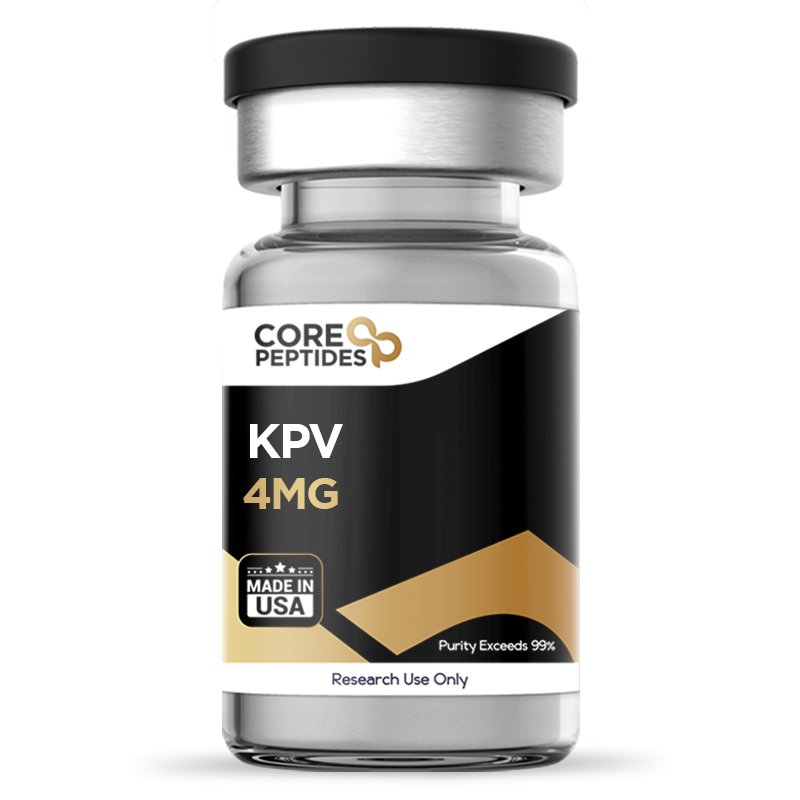
Like other short synthetic peptides supplied for laboratory work, KPV is typically characterized using standard analytical techniques. High-performance liquid chromatography (HPLC) is commonly used to assess purity, while mass spectrometry is used to confirm molecular identity and weight. Reference material such as KPV (4mg) is intended for these kinds of analytical and experimental applications, where a defined, well-characterized tripeptide is required for controlled study. Researchers designing experiments generally record lot-specific analytical data and storage conditions as part of good laboratory practice.
Summary
KPV is the C-terminal tripeptide of alpha-MSH, composed of lysine, proline, and valine. The preclinical literature has explored its anti-inflammatory activity in cell and animal models, with mechanistic attention on NF-kB signaling, cytokine expression, melanocortin receptor and transporter interactions, and its apparent ability to retain activity as a minimal fragment of a larger hormone. Together these studies position KPV as a useful model compound for investigating how small peptide sequences influence inflammatory pathways at the molecular level.
KPV is offered strictly as a research chemical for laboratory and in-vitro use only. It is not a drug, supplement, or medical product, and nothing in this article should be interpreted as describing human or veterinary use. All information above summarizes published preclinical and laboratory research for educational purposes and does not constitute any claim regarding safety, efficacy, or outcomes in humans or animals.