Among the peptides that anchor the innate immune system, few have attracted as much sustained laboratory interest as LL-37 — the only cathelicidin-derived antimicrobial peptide identified in humans. Cleaved from the C-terminal region of the precursor protein hCAP18, this 37-residue peptide takes its name from the two leucine residues at its N-terminus. Over the past three decades, researchers have used LL-37 as a model system for studying how a single small peptide can act at the intersection of direct antimicrobial defense and the broader signaling networks that coordinate innate immunity. This overview surveys the molecular identity of LL-37 and the principal research areas the in vitro literature has explored.
Molecular identity and characterization
LL-37 is a cationic, amphipathic peptide catalogued under CAS 154947-66-7. It is the mature, biologically studied fragment released from human cathelicidin antimicrobial protein (hCAP18) through proteolytic processing. In solution and at membrane interfaces, the peptide adopts a predominantly alpha-helical conformation, a structural feature that laboratory studies have repeatedly linked to its surface activity. Its net positive charge and clustering of hydrophobic and cationic residues along opposite faces of the helix give it the amphipathic character that structural and biophysical investigations focus on.
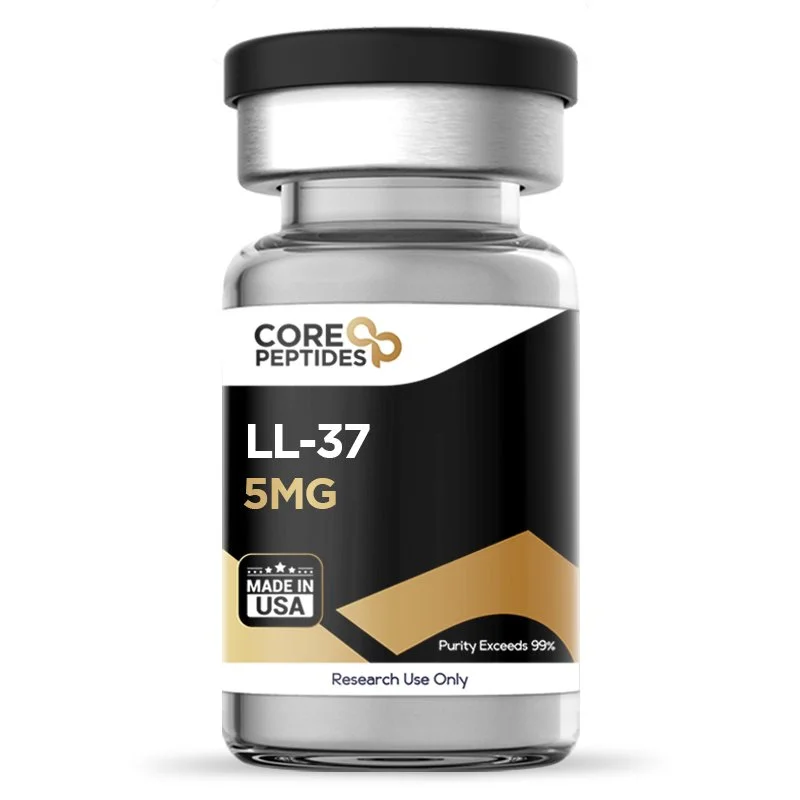
Analytical characterization of LL-37 in a research setting typically relies on reversed-phase high-performance liquid chromatography (HPLC) for purity assessment and mass spectrometry for confirmation of molecular weight, alongside circular dichroism to probe secondary structure under varying buffer, salt, and lipid conditions. Materials supplied for laboratory work, such as LL-37 (5mg), are handled as reference compounds for these kinds of in vitro assays rather than as formulated agents.
Host-defense and antimicrobial pathways studied in vitro
The best-characterized research theme surrounding LL-37 is its behavior as a host-defense peptide. In vitro studies have examined how the cationic helix associates with and disrupts negatively charged microbial membranes, a mechanism frequently modeled using synthetic lipid vesicles and bacterial membrane mimics. Researchers have investigated several proposed models of membrane interaction, including carpet-like surface coverage and transient pore formation, to understand how the peptide perturbs membrane integrity.
- Membrane-disruption dynamics measured against model lipid bilayers and vesicle systems.
- Comparative activity across Gram-positive and Gram-negative bacterial preparations in culture.
- Sensitivity of activity to ionic strength, divalent cations, and serum components in buffer studies.
- Interaction with fungal and biofilm-associated preparations in controlled laboratory assays.
Because these behaviors depend heavily on the surrounding physicochemical environment, much of the literature is concerned with how experimental conditions modulate observed activity — a reminder that in vitro findings describe the molecule under defined laboratory parameters.
LL-37 is frequently studied as a bridge between the classical antimicrobial function of innate peptides and the signaling roles that modulate the wider immune response.
Immunomodulatory signaling in preclinical models
Beyond direct antimicrobial characterization, a substantial body of research treats LL-37 as an immunomodulatory peptide. In vitro and preclinical work has examined its capacity to neutralize bacterial lipopolysaccharide (LPS), a property of interest to investigators studying how innate peptides influence endotoxin-driven signaling cascades in cultured cell systems. Researchers have also investigated the peptide's reported interactions with cell-surface and intracellular receptors, including studies probing chemotactic signaling and the recruitment behavior of immune cells in laboratory assays.
Additional research areas explored in the literature include the peptide's influence on cytokine and chemokine profiles in cultured cells, its interaction with nucleic acids in the formation of immunostimulatory complexes, and its behavior within the crowded protein environment of experimental wound and epithelial models. These lines of inquiry position LL-37 as a tool for dissecting how a single peptide can participate in multiple, sometimes context-dependent, signaling pathways.
Structure–activity relationships
Because LL-37 combines charge, hydrophobicity, and helical structure in a compact sequence, it is a productive scaffold for structure–activity research. Investigators have generated truncated fragments and residue-substituted analogues to map which regions of the sequence drive membrane interaction versus receptor-associated signaling. This work helps researchers separate the peptide's overlapping functions and informs the broader field of engineered antimicrobial and immunomodulatory peptides. Comparative studies with other cationic host-defense peptides — for example, the tripeptide discussed in our KPV research guide — situate LL-37 within a wider class of small peptides examined for innate-immune relevance.
Research history and context
LL-37 entered the scientific literature in the mid-1990s following the identification of the human cathelicidin precursor, and it remains the sole cathelicidin peptide described in humans. Its dual identity — antimicrobial on one hand, immunomodulatory on the other — has kept it central to innate-immunity research and to the broader effort to understand how endogenous peptides contribute to host defense. Readers new to this compound class may find helpful orientation in our overview of what research peptides are, which frames the analytical and handling conventions common to laboratory peptide work. Well-characterized reference material such as LL-37 (5mg) supports the reproducibility that these investigations depend on.
LL-37 supplied by Core Peptides is intended strictly for laboratory and in-vitro research use only. It is not a drug, dietary supplement, cosmetic, or medical product, and it is not for human or veterinary use, diagnostic application, or clinical purposes. All information above summarizes published research areas for educational reference and must not be interpreted as guidance for use in humans or animals.