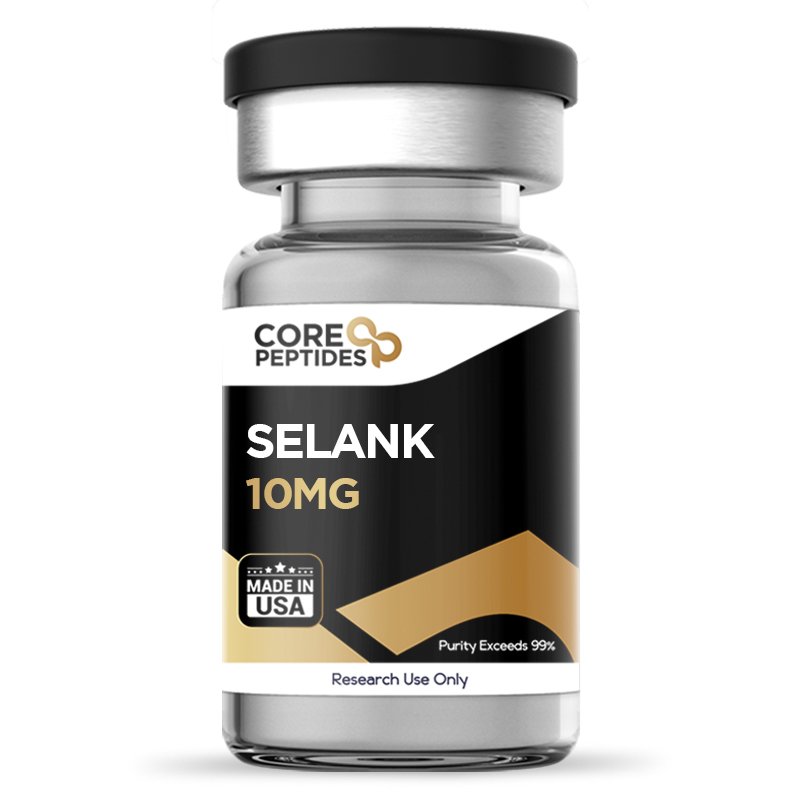
Selank is a synthetic heptapeptide that has become a recurring subject in the preclinical literature on peptide-based modulation of anxiety-related behavior and immune signaling. Structurally derived from the endogenous immunopeptide tuftsin, it belongs to a family of short, proline-rich regulatory peptides that researchers have used to probe the intersection of neurochemistry and immunology in animal models and in vitro systems. This overview surveys what Selank is at the molecular level, how it relates to tuftsin, the distinct N-acetyl variant, and the research areas the scientific literature has explored — strictly within a laboratory context.
Molecular Identity and Characterization
Selank is a linear heptapeptide with the amino acid sequence Thr-Lys-Pro-Arg-Pro-Gly-Pro. It is catalogued under CAS number 129954-34-3, with a molecular formula of C33H57N11O9 and an average molecular weight of approximately 751.9 g/mol. The sequence is notable for its high proline content, a feature that is relevant to how the molecule resists rapid enzymatic degradation relative to shorter parent fragments.
In analytical settings, Selank is typically characterized by reversed-phase high-performance liquid chromatography (HPLC) for purity assessment and by mass spectrometry for identity confirmation. As a research-grade material, it is generally supplied as a lyophilized powder and reconstituted in aqueous or buffered solution for in vitro assays. Batch characterization data — purity percentage, mass, and sequence confirmation — are the standard reference points laboratories use when evaluating a lot such as Selank (10mg) for experimental work.
The Tuftsin Relationship
Selank was designed as a synthetic analog of tuftsin, a naturally occurring tetrapeptide (Thr-Lys-Pro-Arg) that corresponds to a fragment of the heavy chain of immunoglobulin G. Tuftsin has long been studied for its immunomodulatory activity, but as a short native peptide it is susceptible to rapid cleavage by peptidases, which limits its utility as a stable experimental probe.
The Selank sequence extends the tuftsin core at the C-terminus with three additional residues (Pro-Gly-Pro). Researchers have described this elongation as a strategy intended to increase metabolic stability and prolong the molecule's persistence in biological media, while retaining the tuftsin-derived pharmacophore. This structure–stability relationship is a central reason Selank appears so frequently in the literature as a tool for investigating tuftsin-associated pathways under controlled conditions.
Selank exemplifies a common medicinal-chemistry approach in peptide research: taking a short, biologically interesting but unstable native fragment and appending residues to improve its behavior as a reproducible experimental reagent.
Research Areas Explored in the Literature
The published preclinical record on Selank spans several overlapping domains. Investigators have examined the compound across the following broad areas:
- Anxiety-related behavioral models. Much of the animal-model literature has positioned Selank within studies of anxiolytic-type activity, often using standard rodent behavioral paradigms to characterize responses.
- Immunomodulation. Reflecting its tuftsin lineage, Selank has been studied for effects on immune signaling and cytokine-related pathways in cellular and animal systems.
- Neurochemical signaling. Researchers have investigated its interactions with monoaminergic and GABAergic systems and with the expression of neurotrophic and neuropeptide-related factors in preclinical settings.
- Peptide stability and metabolism. The compound's resistance to enzymatic breakdown, relative to tuftsin, has itself been a subject of analytical interest.
Across these areas, the literature is characterized as exploratory and mechanistic. Selank is used as a molecular probe to ask how a tuftsin-derived structure behaves in defined biological systems, rather than as a settled intervention.
The N-Acetyl Selank Variant
A structural variant, N-acetyl Selank, appears in the research literature as a modified form of the parent peptide. In this analog, an acetyl group is added at the N-terminus of the sequence. N-terminal acetylation is a widely used modification in peptide chemistry, and researchers have generally studied it as a means of altering a peptide's stability profile and its resistance to aminopeptidase activity.
Investigators comparing the acetylated and non-acetylated forms typically frame the modification in terms of pharmacokinetic and stability characteristics observed in preclinical systems, alongside analytical differences in mass and chromatographic behavior. For laboratories conducting side-by-side structural comparisons, a characterized reference lot of N-Acetyl Selank (10mg) is used as the acetylated counterpart to the base heptapeptide. The core Thr-Lys-Pro-Arg-Pro-Gly-Pro sequence is conserved between the two; the acetyl group is the defining structural distinction.
Selank in the Context of Regulatory Peptide Research
Selank is frequently discussed alongside other short synthetic peptides that emerged from the same broad research tradition of engineering endogenous fragments into more stable analogs. Readers examining this class of molecules often review it in parallel with related nootropic-adjacent research peptides — for example, the material covered in our Semax research guide — and with the general principles outlined in what are research peptides. Placing Selank within this wider family helps clarify why its proline-rich, tuftsin-derived architecture is of methodological interest to peptide chemists and neuropharmacology researchers.
It is worth emphasizing that the body of Selank research is heterogeneous in scope and origin, and that mechanistic questions about its pathways of action remain areas of ongoing scientific investigation rather than resolved conclusions.
Research-use-only notice. Selank and N-Acetyl Selank are offered strictly for laboratory and in-vitro research purposes only. The information in this overview is educational and describes molecular identity, structural relationships, and published research areas. Nothing here is intended to describe, recommend, or imply any human or veterinary use, and these materials are not drugs, dietary supplements, or products for human or animal consumption.