Semax is a synthetic heptapeptide that has become a recurring subject in neuropeptide research, particularly within studies of neurotrophic signaling and central nervous system biochemistry. Structurally derived from a fragment of adrenocorticotropic hormone, it belongs to a family of short peptides that researchers have examined for their interactions with neurotrophin pathways in laboratory and animal-model settings. This overview summarizes what the compound is, how it is characterized analytically, and which research areas the scientific literature has explored — including the closely related N-acetyl variant, which is studied for its altered stability profile.
Molecular Identity and Origin
Semax is commonly described as an ACTH(4-10) analog, referencing the region of adrenocorticotropic hormone that early researchers identified as retaining neurotropic activity independent of the hormone's classical endocrine signaling. The peptide carries the amino acid sequence Met-Glu-His-Phe-Pro-Gly-Pro, in which the N-terminal ACTH(4-7) fragment (Met-Glu-His-Phe) is joined to a C-terminal Pro-Gly-Pro tripeptide. It is cataloged under CAS 80714-61-0. The compound was originally developed by investigators at the Institute of Molecular Genetics of the Russian Academy of Sciences as part of a program studying which portions of the ACTH molecule preserved effects on neural tissue while omitting adrenal-stimulating activity.
The Pro-Gly-Pro extension is not incidental. This C-terminal tripeptide is a defining feature of the molecule's design, intended to influence how the peptide resists enzymatic breakdown relative to the unmodified ACTH fragment. For laboratories comparing analogs, this structural motif is a common point of analytical interest.
Analytical Characterization
As with other research peptides, Semax is typically supplied as a lyophilized powder and characterized by reversed-phase high-performance liquid chromatography (HPLC) for purity, alongside mass spectrometry for identity confirmation against the expected molecular mass of the heptapeptide. Researchers working with the compound generally reference a certificate of analysis to confirm sequence identity, net peptide content, and the absence of significant process-related impurities before designing experiments.
- Peptide class: synthetic linear heptapeptide (ACTH(4-10) analog)
- Sequence: Met-Glu-His-Phe-Pro-Gly-Pro
- CAS number: 80714-61-0
- Typical characterization: HPLC purity assessment and mass-spectrometric identity confirmation
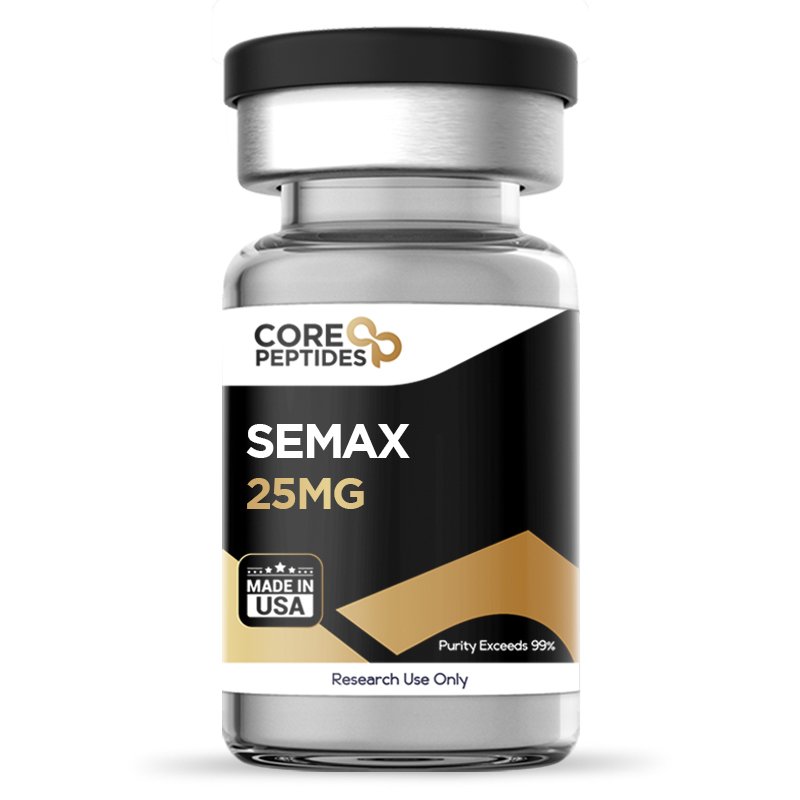
Reference-grade material for these analytical workflows is available as Semax (25mg) for laboratory research applications.
Neurotrophic and BDNF Pathway Research
One of the most frequently studied aspects of Semax in the preclinical literature is its relationship to neurotrophic factor signaling. Researchers have investigated how the peptide associates with expression of brain-derived neurotrophic factor (BDNF) and its cognate receptor TrkB in rodent brain tissue, most often in hippocampal regions. These studies examine changes in neurotrophin messenger RNA and related receptor signaling as molecular readouts, using standard techniques such as quantitative PCR, immunoblotting, and immunohistochemistry in animal models.
Related lines of inquiry in the literature have looked at nerve growth factor (NGF) expression and at markers associated with neuronal stress responses. Because Semax is a peptide fragment analog rather than a receptor-specific ligand, a portion of the research effort has focused on clarifying the molecular intermediates through which it may associate with neurotrophin systems in cell and tissue models.
The joining of an N-terminal ACTH(4-7) fragment to a Pro-Gly-Pro tripeptide is the structural hallmark that distinguishes Semax from the parent ACTH sequence and frames much of the comparative peptide-stability research surrounding it.
The N-Acetyl Semax Variant and Stability
N-Acetyl Semax is a structural analog in which the N-terminus of the peptide carries an acetyl modification. In peptide chemistry, N-terminal acetylation is a well-established strategy for altering how a peptide interacts with aminopeptidases, the enzymes that cleave residues from the free amino terminus. Researchers studying acetylated analogs are generally interested in how this modification changes the compound's stability and degradation kinetics under experimental conditions compared with the unmodified parent peptide.
In the context of Semax research, the N-acetyl variant is examined as a distinct molecular entity, and comparative studies may evaluate differences in enzymatic resistance and biochemical behavior between the two forms. Laboratories investigating these structure–stability relationships can source the analog as N-Acetyl Semax (25mg). As with all such comparisons, the modification is studied as a chemical and analytical property, not as a functional claim.
Position Within Peptide Research
Semax is frequently discussed alongside other short synthetic peptides investigated in central-nervous-system research. Readers building broader context may find it useful to review related material on the regulatory-peptide research landscape in the Selank research guide, and to review foundational background in the overview of what research peptides are. Together these resources situate Semax within the wider category of sequence-defined peptides that laboratories characterize and study in vitro and in animal models.
Summary
Semax is a synthetic ACTH(4-10) heptapeptide analog (CAS 80714-61-0) distinguished by its C-terminal Pro-Gly-Pro tripeptide, and it has been examined in preclinical research for its associations with neurotrophic signaling pathways, including BDNF and TrkB, in rodent models. Its N-acetyl variant is studied primarily for the stability differences introduced by N-terminal acetylation. Across this body of work, the compound is treated as a research tool for probing peptide biochemistry and neuropeptide pathways.
Research-use-only notice: All products and information referenced here are intended strictly for laboratory and in-vitro research use. Semax and N-Acetyl Semax are not drugs, dietary supplements, or medical products, and nothing above should be interpreted as describing use in humans or animals outside of controlled scientific research. These compounds are not approved for diagnostic, therapeutic, or any other application beyond laboratory investigation.