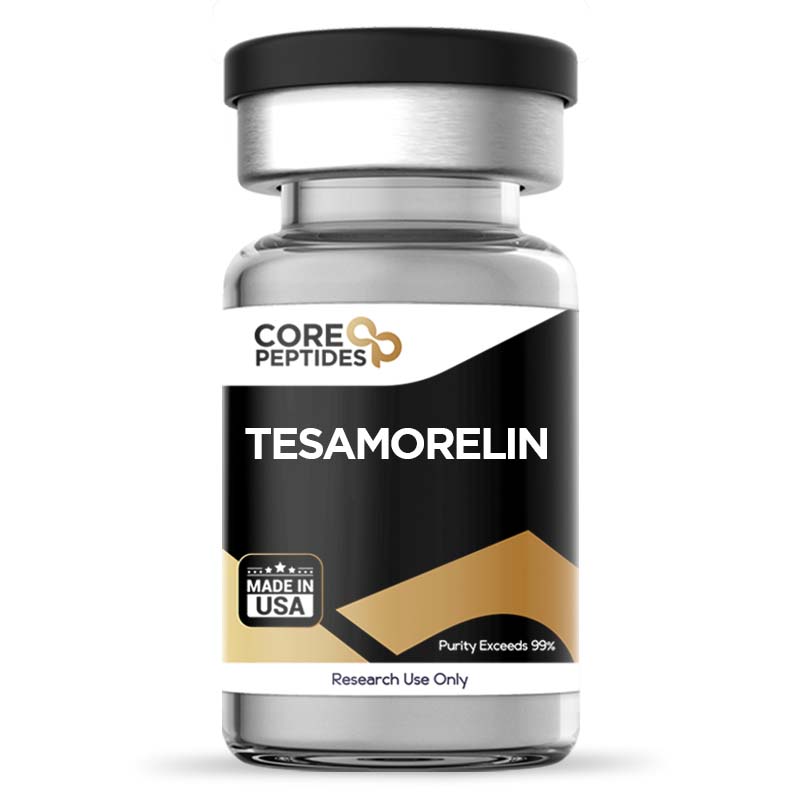
Tesamorelin is a synthetic analog of growth hormone-releasing hormone (GHRH) that has become a reference compound in laboratory investigations of the somatotropic axis. Structurally derived from the full-length human GHRH(1-44) sequence, it carries a single, deliberate chemical modification designed to resist enzymatic breakdown. This combination of a native-like receptor-binding sequence with engineered metabolic stability has made Tesamorelin a frequently characterized peptide in preclinical and in vitro research on endocrine signaling. The overview below summarizes its molecular identity, the basis of its structural stabilization, and the research contexts in which it has been studied.
Molecular Identity and Characterization
Tesamorelin is identified by CAS number 218949-48-5. In analytical characterization, it is described as a 44-residue peptide corresponding to the sequence of human GHRH(1-44), modified at the amino terminus. Because it is a large, defined-sequence peptide, laboratory characterization typically relies on techniques common to peptide analysis, including reversed-phase high-performance liquid chromatography (HPLC) for purity assessment and mass spectrometry for confirmation of molecular mass and sequence integrity.
Researchers handling the compound as a reference material commonly document identity, purity, and lot-to-lot consistency. The compound is available to laboratories as Tesamorelin (10mg) for use in controlled experimental settings.
Native GHRH and the Stability Problem
Native growth hormone-releasing hormone is a hypothalamic peptide that binds the GHRH receptor (GHRHR), a class B G-protein-coupled receptor expressed on somatotroph cells. A well-documented feature of native GHRH is its short biochemical half-life. The peptide is rapidly cleaved by dipeptidyl peptidase-4 (DPP-4), an enzyme that removes the N-terminal dipeptide and thereby inactivates the molecule. This susceptibility to proteolysis has historically complicated the experimental use of unmodified GHRH, motivating the design of analogs with greater metabolic resistance.
Structural Stabilization Versus Native GHRH
The defining structural difference between Tesamorelin and native GHRH is the addition of a trans-3-hexenoyl group (a C6 acyl side chain) anchored to the N-terminal tyrosine residue. This N-terminal acylation is the basis of the compound's enhanced stability profile relative to the unmodified peptide.
The mechanistic rationale studied in the literature centers on protection of the cleavage site:
- The acyl modification shields the amino-terminal region that DPP-4 targets, reducing the rate of enzymatic degradation observed with native GHRH.
- Preserving the N-terminal region is significant because this portion of the molecule is important for receptor engagement, so the modification aims to retain receptor-relevant structure while improving resistance to proteolysis.
- The remainder of the 44-residue backbone retains the human GHRH sequence, keeping the analog closely related to the endogenous ligand in its receptor-binding architecture.
The design logic of Tesamorelin illustrates a broader principle in peptide chemistry: a single, targeted N-terminal modification can markedly alter a peptide's stability against proteolytic enzymes while preserving the core sequence responsible for receptor recognition.
Receptor Pathway and Mechanistic Research
In mechanistic studies, Tesamorelin is characterized as a GHRH receptor agonist. Binding of GHRH-family ligands to the GHRHR activates downstream signaling associated with class B GPCRs, classically involving adenylate cyclase activation and cyclic AMP as a second messenger within somatotroph cells. Research using cell-based and animal models has examined how a stabilized GHRH analog interacts with this pathway compared with the native peptide, providing a tool for probing the physiology of the GHRH-somatotroph signaling system under laboratory conditions.
Because it engages the same receptor as endogenous GHRH, Tesamorelin is often discussed within the broader family of secretagogue peptides. Comparative context on this class is covered in the growth hormone secretagogues overview, which situates GHRH analogs alongside other peptides that act on related pathways.
Metabolic-Research Context
The metabolic-research context in which Tesamorelin has been studied preclinically centers on the biology of the somatotropic axis and its connections to metabolic signaling. In animal models and in vitro systems, researchers have used GHRH analogs as investigational tools to explore the regulation of the growth hormone axis and associated signaling pathways. As a metabolically stabilized analog, Tesamorelin offers a more persistent experimental probe than native GHRH, which is one reason it appears frequently in this line of laboratory inquiry.
Investigations in this area typically focus on molecular mechanisms — receptor activation, signaling cascades, and the enzymatic stability of the peptide itself — rather than any applied outcome. The literature treats the compound as a means of interrogating a well-defined endocrine pathway.
Comparison With Related Analogs
Tesamorelin is one of several GHRH-related peptides examined in research settings. It is frequently discussed alongside shorter analogs of the GHRH sequence, which differ in length and modification strategy. Sermorelin, for example, corresponds to a truncated GHRH fragment and is characterized separately; a dedicated Sermorelin research guide outlines that compound's distinct profile. Comparing full-length stabilized analogs such as Tesamorelin with truncated fragments is a recurring theme in structure-activity studies of the GHRH family, where sequence length, N-terminal modification, and proteolytic stability are the primary variables of interest.
Handling and Analytical Notes
As a lyophilized peptide reference material, Tesamorelin is typically stored and reconstituted according to standard peptide-handling practices used in analytical laboratories, with attention to conditions that preserve peptide integrity. Confirming purity and identity by chromatographic and mass-spectrometric methods before experimental use is standard practice when working with defined-sequence peptides of this size.
Research-use-only statement. The information in this article is provided solely for educational and laboratory-research purposes. Tesamorelin is offered strictly for in-vitro and preclinical laboratory research use only. It is not a drug, dietary supplement, or medical product, and nothing herein describes or implies any human or veterinary use, diagnosis, treatment, or outcome. All handling and experimentation must be conducted by qualified personnel in an appropriately controlled research environment and in accordance with applicable laws and institutional guidelines.